Researchers say this lost world, called Theia, likely shared the same early neighbourhood as our planet.
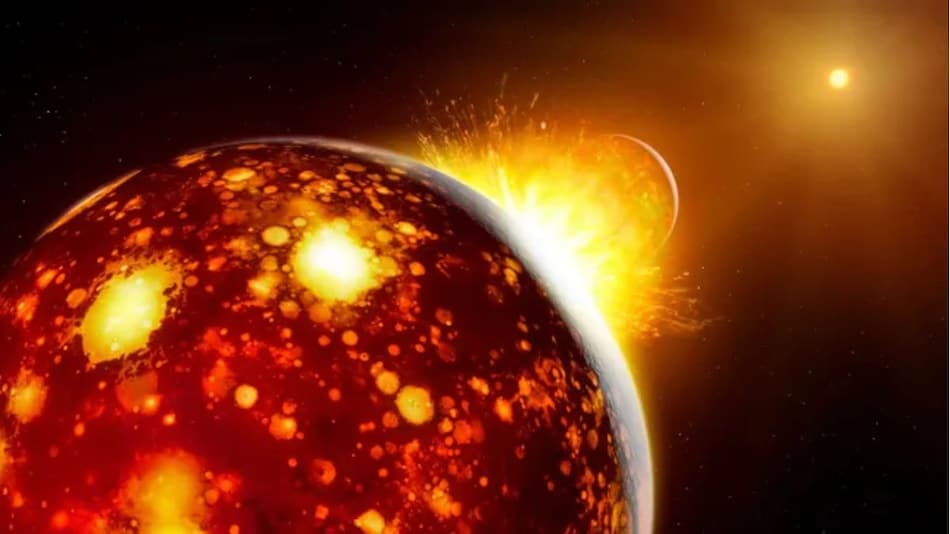
An illustration of the ‘giant impact’ between Earth and the proto-planet Theia
Click Here to Add Gadgets360 As A Trusted Source

Earth may not have to look quite so far for its moon because when our young planet was in a catastrophic collision with a nearby protoplanet, the event might have jettisoned enough planetary debris into Earth’s orbit to form the moon, according to new research involving Apollo samples and ancient rocks. The new study indicates, however, that the colossal impact that formed the moon was not caused by a distant object but by an adjacent rocky planet that grew up alongside Earth.
Researchers say this lost world, called Theia, likely shared the same early neighbourhood as our planet. The findings now offer one of the clearest clues yet about the violent events that shaped Earth’s early history.
New Study Reveals Theia’s Origin
According to a report in Science journal, researchers examined tiny chemical traces inside Earth’s mantle and Apollo lunar samples to understand where Theia was born. They discovered that iron and molybdenum isotopes in Earth and the moon match material from the inner solar system, suggesting Theia was a nearby sibling world, not a distant wanderer.
The team analysed rocks from Hawaii’s Kīlauea volcano and Antarctic meteorites, comparing them with computer models. Only one scenario matched: Theia was a rocky body with 5–10 percent of Earth’s mass.
Mystery of the Moon’s Creation
Scientists believe Theia and early Earth contained material from very close to the Sun, a type not found in meteorites. Future samples from Venus or Mercury may help confirm this missing component.
Researchers now aim to learn how the collision blended both worlds so completely, a key puzzle that could reveal the final chapter of how Earth and the moon formed.